1 Talents express themselves outside categories; this is what makes vocational education difficult.
2 The timeless is what truth is based on, and truth is an attempt to reach the timeless, at least an Archimedean point.
“…Here one may expect this objection: what, then, about surrealism, where it is precisely precision that makes stylistic demands? For that reason, in surrealism precision moves away from mere copying, and from photographic copying as well. Among photographers, at any rate, there are also good set designers, who do not copy the object but bring it into the dimension proper to it. Things that are too precise do not strengthen reality, but undermine it. Hence the impression: one must take a good look again. The intellect imposes a demand by which the work of art is weakened… The other side of the coin is the avoidance of objects. Eyes trained on objects find it hard to judge the rank of what is shown there. A degree might be reached at which the scissors disappeared as an object and yet remained the subject of the painting — there would be an approach to music. The unicorn emerges from the shadow zone.
3 Absolute precision is a contradiction, and «absolute perfection a pleonasm»; there’s the problem. Of course the universe as a whole could also be arithmetic, but human precision is an attempt to approach that absolute.
4 The mishmash is not universality; it is cosmopolitan. Within a galaxy there are various things of differing universality, which become more or less conformal.
5 To separate with ill will is a contradiction, a difference that makes no difference: it is separating without separating.
6 As Jünger says, precision has grown enormously; we have atomic clocks (the age of radiation) that don’t lose time for thousands of years. This is a far more absolute, more perfect, more comprehensive precision.
7 «Precision does not reinforce reality but attacks it; hence this experience we have: one must look again.» In the «eternal return»1 precision also copies or emulates the model; that turn or return is the echo of a totality that neither began nor ends.
8 HH: On the limits of surrealism and the Tantalean hunger for precision: in the «eternal return,» precision also copies the model; that turn or return is the echo of a totality that neither began nor ended; the «eternal return» may not be of the universe, but it could well be of one of its worlds. So the eternal return is the foundation and basis of all precision, and is more absolute than it. Xz
Surrealism too is pure copy; the «eternal return» is the pure copy of a universe that neither began nor ends, of a universe that is more than eternal return, that is timeless: the «eternal return» is more absolute than precision. Xz
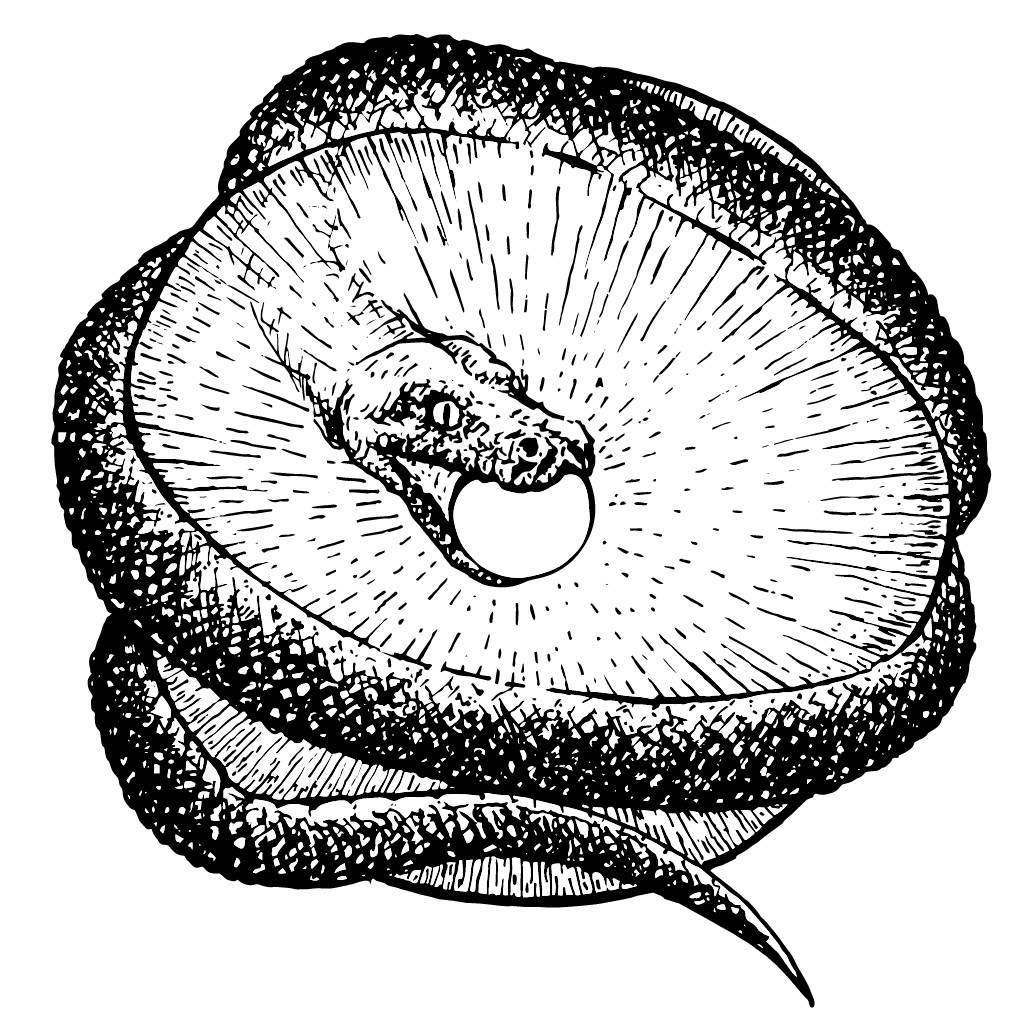
The «eternal return» not as an object but as «eternal return»; a rendezvous like that says something: ouroboros, 0. Xz
References
- Friedrich Nietzsche
- Ernst Jünger — La Tijera, Af. 98.
Here this objection is to be expected: what, then, about surrealism, where what makes stylistic demands is precisely precision. For this reason, in surrealism precision moves away from mere copying, from photographic copying as well. Among photographers, at any rate, there are also good scenographers, who do not copy the object but bring it into its proper dimension. Things that are too precise do not reinforce reality, but attack it. Hence this impression: one must look closely again. The intellect imposes a demand by which the work of art is weakened… The other side of the coin is the avoidance of objects. To eyes trained on objects it is difficult to judge the rank attained by what is shown there. Such a degree might be reached that the scissors disappeared as an object and yet continued to be the subject of the painting - there would be an approach to music there. The unicorn emerges from the shadow zone.