1 «The one who does not know where he is going goes the farthest»1. So «the final sum»2 is not a place, is not a position. The final sum allows everything to be added to the goal.
2 Rarefaction, eternal return, symmetrical transparencies, and precision are the movements of the universe.
3 Heraclitus’s bow. Multiplication is the result of the tension reached by separating life’s «for» from life’s «that.»
4 It's interesting that without effort we can't make use of solutions to problems, even when they're obvious and simple. This shows that there is no opposition between that mastery that achieves a great deal with very little, and getting things done through effort.
Even if there is a distinction, it is not an opposition. In effort one may be doing things the master does with ease: it is something like doing that, but without skill. That is what also gives Saint Paul’s gaze, and all crude mechanics, their value.
What there is, though, is a distinction, in the sense that skill is better; but from victory, in any case, there follows, «the sum that cures all»3.
5 «In the fruit, it is true, perfect roundness is reached»4, but this is a secondary aspect, though a necessary one. The fruit is, to a greater extent, a final sum.
6 The titan has his eye on the last move, not on the final sum; by contrast, if we conceived of the hero as «a Roman Caesar with the soul of Christ»5, he would not have «the need for an external reader, for a poet»6; the life Elon Musk lives, I wouldn’t want that to be mine.
7 Everything points toward the preeminence of 0, but in mathematics in an intricate way.
Value exists beyond what stands out; almost all value does not stand out; from our perspective, the greatest value lies in the invisible.
Even the cosmos keeps expanding; we are far more significant and insignificant than we think.
The 0 absorbs everything into itself; it has the greatest gravity. Isn’t it interesting that even in our mathematical genius we picture the heavenly bodies? That can be seen in the sign for 0.
Of course we could picture it another way, but in the final sum. When things settle, nature coincides down to its smallest details.
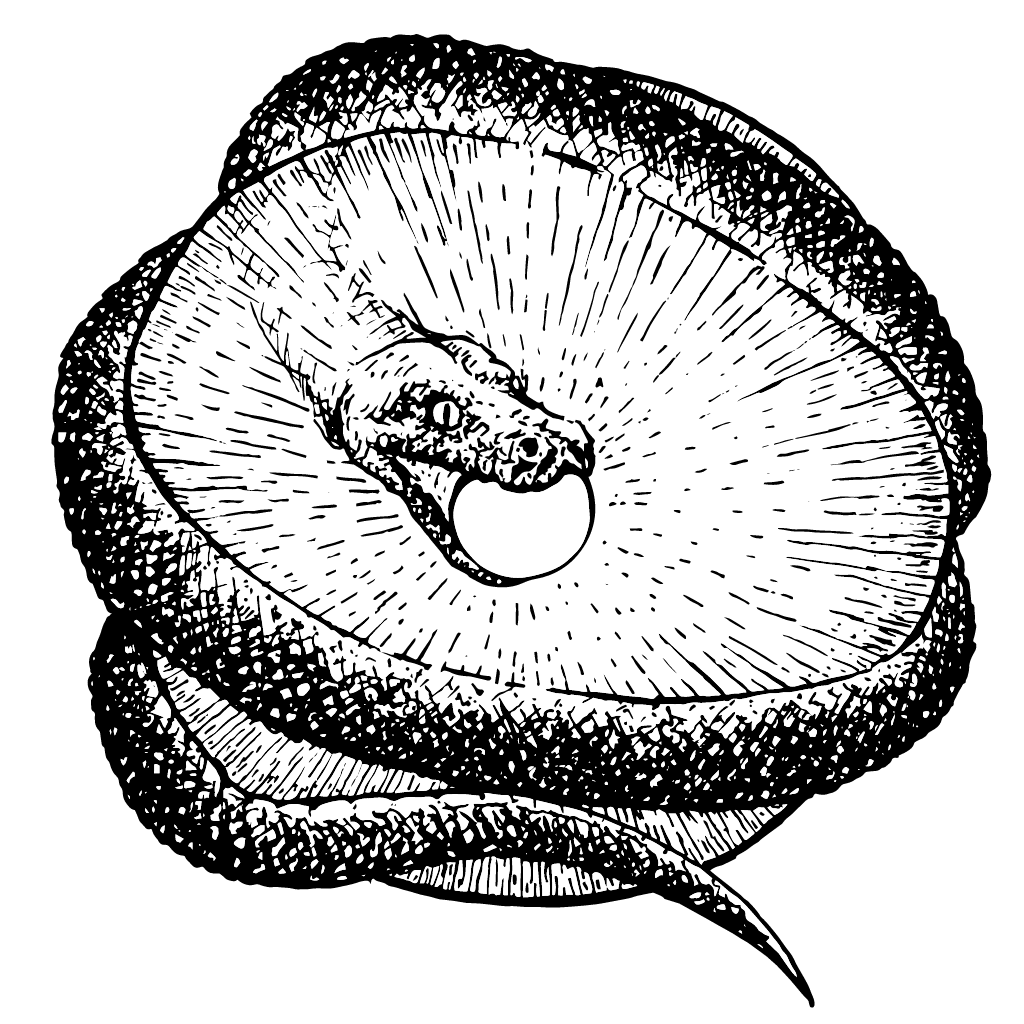
8 Ouroboros. Even as we wake, «in the bite of the day before»7, as in everything titanic, what guides is the will to power. Nothing to fault it for; it is at once necessary, but also secondary in the sequence.
«The main thing, instead, comes from the unexpected; hence the best insights are the ones that surprise us ourselves.»8
That second bite of the will to power, which as we said cannot be missing, is preceded by the encompassing that we call dreams, which are already conceptions (children) of substance with our waking life.
Dreams are not «the fulfillment of unfulfilled wishes»; Freud, at least at one stage, saw them that way. Dreams had already sprung forth and been conceived with waking life while we dream them; what does remain invisible is «the substance from which the encompassing takes place»9, that with which we directly conceive «with and in» waking life.
Perhaps the guide (the will to power) is secondary compared with the impact on our lives of the dreams we conceive with waking life.
9 Difference between mastery and effort: what seems insignificant to effort is later a fundamental subtlety in mastery.
References
- Goethe
- Ernst Jünger — An der Zeitmauer
The gain does not lie in the last move, but in the final sum.
- Napoleón Bonaparte
Victory heals everything.
- Ernst Jünger — La Tijera
- Friedrich Nietzsche — La voluntad de poder, Af. 983.
- Ernst Jünger — La Tijera, Af. 141
…There is, at any rate, a temptation lying in wait, which consists in transferring to the world the dimensions acquired there—it is something that begins already with the «playing Indians» of the boy who became enthralled with Winnetou. The reader does not want to act or think or take sides in any way, not even morally; he leads a charmed life in pure intuitive contemplation. At higher levels the reader is superior even to the hero, for the latter needs the poet to grant him his blessing; he needs Homer.
- Einar Barfod — Entrevista en Radio Sarandí
- Ernst Jünger — Máximas y mínimas a El Trabajador
- Goethe
Ideas spring from substance.